
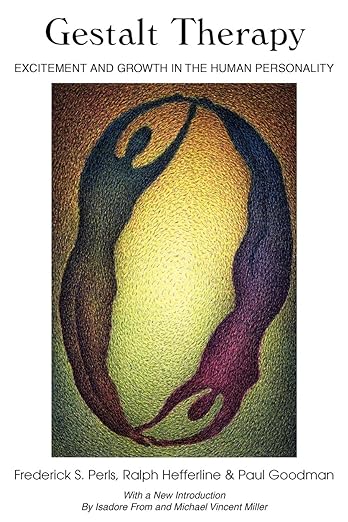
Notes from Gestalt Therapy’s seminal book by Fritz Perls, Ralf Hefferline and Paul Goodman, Published in 1951 republished in 1994, entitled, “Gestalt Therapy: Excitement and Growth in the Human Personality.
The book starts with a preface discusses key differences between Gestalt Therapy and Psychoanalysis, from which Gestalt Therapy evolved.
On Aggression Gestalt Therapy vs. Psychoanalysis
Gestalt therapy views aggression positively, in contrast to Freud’s association with the death instinct. Perls theorized aggression stems from “dental aggression,” a process of selectively internalizing experiences. This fosters self-preservation, environmental interaction, and creative agency. Gestalt therapy views the “no” as equally important to the “yes” in healthy personality development. Its repression, due to fear of conflict, is believed to be a core driver of neurotic tendencies.
All psychotherapeutic approaches hold implicit or explicit views on human development. Psychoanalysis encourages regression and reintroduces introjection through interpretation, while Gestalt therapy emphasizes early development of self-determination. Gestalt therapy integrates interpretation with patient-led experiments fostering self-discovery. Importantly, this includes encouraging patients to actively resist or critique the therapist’s interpretations.
On Aggression Gestalt Therapy vs. Psychoanalysis- The Structure of Growth 1. The Contact Boundary
Chapter V: Maturing and the Recollection of Childhood- Chapter VI: Human Nature and the Anthropology of Neurosis- Chapter VII: Verbalising and Poetry- Chapter VIII: The Antisocial and Aggression- Chapter IX: Conflict and Self-Conquest- Chapter XII: Creative Adjustment 1. Fore-contacting and Contacting Physiology and Psychology- Fore-contact: Periodic and Aperiodic- First stages of Contact- Gratuitous Creativity- Creativity / Adjustment- Emotions- Excitement and Anxiety- Identifying and Alienating
Final Contact and Post Contact Unity of Figure and Ground- CONCERN and Its object- Example of Sexual Touch etc- Post Contact- Passagefrom the psychological to the Physiological- Formation of personality: Loyalty- Formation of Personality: Morality- Formation of Personality:Rhetorical Attitudes
CHAPTER XV: LOSS OF EGO-FUNCTIONS Loss of Ego-Functions: A Neurotic Adaptation- The “Characters” of Interruption: Five Mechanisms (1) Confluence – No Contact or Boundaries- (2) Introjection – Swallowing the Environment- (3) Projection – Disowning Emotion- (4) Retroflection – Turning Against the Self- (5) Egotism – Deliberate Delay or Avoidance
3. Summary: The Interruption Table- 4. From Typology to Therapy- 5. The Criterion of Health: Creative Flow
VOLUME II: Chapter 1: Mobilising the self Part I: The Limitations of Experimental Psychology- Part II: The Clinical Approach and Its Validity- Part III: The Illusion of Impersonality in Science- Part IV: Gestalt Psychology as a Bridge- Towards a Human Science
Volume II: Chapter 2 CONTACTING THE ENVIRONMENT (EXPERIMENTS) Experiment 1: Experimenting with Actual- Experiment 2: Sensing opposed forces- Experiment 3: Attending and Concentrating- Experiment 4: Differentiating and Unifying- Destruction and Reconstruction: Reorganizing the Self- Integration and Beyond
The Structure of Growth
1. The Contact Boundary
“Experience occurs at the boundary between the organism and its environment, primarily the skin surface and the other organs of sensory and motor response.” (p. 3).
Interaction of Organism and Environment
Experiences occur at the boundary between Organism and Environment. The point of contact is where the Self meets the environment. The self is always in contact with the environment. When we breathe, our lungs come into contact with atmospheric oxygen in the environment.
Contact in the context of human interaction means different things in English. E.g. when we say “I contact you” means to give someone a call or a text message. Contact in Gestalt therapy, is a theoretical concept, which describes a process of awareness. This process is ever changing and dynamic.
“Experience occurs at the boundary between the organism and its environment, primarily the skin surface and the other organs of sensory and motor response.”
Contact boundary connects and separates the organism and environment.
“When we say “boundary” we think of a “boundary between”; but the contact-boundary, where experience occurs, does not separate the organism and its environment; rather it limits the organism, contains and protects it, and at the same time it touches the environment.” (p.5)
Contact is dynamic and creative because contact with the environment is novel. Contact is not passive but an active process, which must end with assimilation. “All contact is a creative adjustment between organism and environment”. It is how the organism grows in the field. Interruption of contact hinders movement and growth.
Creative and adjustment are polar and mutually necessary.
The figure of contact against the **ground **of the organism/environment field is clear and vivid. The figure/ground formation is a dynamic one.
Gestalt therapy focuses on the ‘contact boundary,’ the dynamic interface between self and other. This boundary is where experiences unfold, needs are met or thwarted, and growth occurs through interactions with the environment. The therapist’s role is not to analyze the past but to help the patient identify and work through present anxieties that hinder their capacity for contact and growth.
Therapy is a process of analysing Gestalt, where the therapist looks out for interruptions to the contact through what is said, body language and the chatacter of the therapeutic encounter.
Chapter V: Maturing and the Recollection of Childhood
This chapter explores the role of memory and anticipation in present experience, specifically in the context of psychotherapy. It argues against an overemphasis on recovering past memories or future plans, but instead focuses on present self-awareness and creative adaptation. The emphasis here is on the importance of working with the present experience in therapy, while acknowledging the influence of past experiences on how we function in the present. Therapists and patients should celebrate the value of so-called “childish” traits. It argues that true “maturity” involves reclaiming the joyful and vital aspects of childhood often lost in a restrictive adult world.
Past and Future in the Present Actuality: Memories and plans are present acts of imagination. Dwelling on the past or future can be unproductive, leading to feelings of regret, guilt, or inadequacy. True self-worth comes from actively engaging in the present.
The Importance of Past and Future in Therapy: While recovering past memories can be helpful, it’s not the sole focus. Therapy aims to expand the patient’s “self” by addressing underlying patterns and unfinished situations from the past that continue to impact the present.
Past Effects as Fixed Forms in the Present: The past affects us through fixed forms in the present, such as habits or memories. These can be either healthy (e.g., useful skills) or neurotic (e.g., compulsive behavior).
The Compulsion to Repeat: Neurotic behavior stems from a need to repeat an uncompleted situation from the past. This repetition is unsuccessful because the circumstances have changed, and the fixed attitude used is outdated.
The Structure of a Forgotten Scene and its Recall: Repressed memories function like bad habits, actively suppressed in the present. Recalling them involves relaxing the present inhibition, allowing the underlying feelings and the associated memory (the “scene”) to resurface.
The “Trauma” as Unfinished Situation: The chapter rejects the idea that recovering repressed memories is the sole focus of therapy. It emphasizes that the primary task is to free the underlying feelings and attitudes which were blocked at the time of the trauma.
**The Therapeutic use of the Recovered Scene: **the recollection of the therapeutic scene serves to bring into awareness renewed flooding of feelings associated with the traumatic event. This allows the client to explain to himself what the feelings mean and express them in the safety of the present.
The Erroneous Conception of “Infantile” vs. “Mature” : The authors strongly critique the use of these terms. They argue that many so-called “infantile” traits like spontaneity, playfulness, and direct curiosity are essential for a fulfilling adult life.
What is True Maturation? The authors suggest that rather than fixating on “growing up”, we need to recover the valuable and joyful elements of childhood. They point out that many supposed hallmarks of maturity are, in fact, signs of neurosis.
Freud’s View on Maturation: The chapter analyzes Freud’s ideas on maturation, acknowledging that while he made a sharp split between childhood and adulthood, he often valued the “child heart.”
Childish Emotions and “Reality”: The authors challenge Freud’s idea that mature people adapt to reality by suppressing desire. They argue children can engage with reality through play and imagination, traits that inflexible adults often lack.
Chapter VI: Human Nature and the Anthropology of Neurosis
Psychotherapy must consider social, cultural, and biological factors in human development. “Normality” isn’t always a healthy goal within a dysfunctional society. Neurosis reveals where society fails to support the thriving of its members. Evolutionary changes influence current anxieties and coping mechanisms.
1: The Subject-Matter of Anthropology Anthropology studies the relationship between human biology and culture. Understanding these connections helps us recognize the “lost” human powers that often contribute to our current social and psychological problems.
2: The Importance of this Subject for Psychotherapy Psychotherapy must go beyond biological health to address the uniquely human aspects: feelings, interests, and societal influences. A therapist can’t assume “normal” adjustment to a dysfunctional society is the goal. Instead, the goal is helping patients create a more fulfilling life even within societal constraints.
3: “Human Nature” and the Average In a healthy society, cultural norms would define a thriving human. Since our institutions are often harmful, a therapist must look beyond them. Many patients seeking psychotherapy are not “sick” but desire greater fulfillment. This suggests they have potential exceeding the average – a factor for therapists to consider.
4: Neurotic Mechanisms as Healthy Functions Neurosis is a relatively recent human adaptation. The mechanisms behind it (hallucination, isolation, etc.) are safety-valves for protecting the self in the face of overwhelming threat. In neurosis, these safety mechanisms overshadow more “normal” functions. This highlights societal dysfunction, where “normal” behaviors are the root cause of the problem. The therapist’s goal is not to eliminate these valuable self-protective mechanisms but to help the patient integrate them healthily.
5: Erect Posture, Freedom of Hands and Head
Advantages: Upright posture improved perception, manipulation, and abstract thinking.
Disadvantages: This led to a disconnect between the head and its more instinctual senses (smell, taste). It also made isolation and the fear of falling new anxieties.
Consequences: While the ability to abstract and analyze improved, some immediacy in sensing the environment was lost. This can lead to getting stuck in past experiences rather than engaging fully in the present.
6: Tools, Language, Sexual Differentiation, and Society
Tools & Language: These emerged from our heightened ability to abstract and symbolize. While useful, they can lead to a disconnect if we mistake these abstractions for the primary source of connection with ourselves, others, or the world.
Sexual Differentiation: Intricate sexual systems evolved for reproduction, strengthening social bonds. However, this complexity also creates vulnerabilities in individual well-being, especially with the potential for social exploitation.
7: Differentiations of Sensory, Motoric, and Vegetative
- The Split: The separation of sensory/thought centers from motor control greatly improved deliberation and action planning. In neurosis, this split can become a means to prevent spontaneity and block the embodied experience of thought translating into action.
8: Verbal Difficulties in this Exposition
Complexities of “Self”: Discussing human development highlights the blurred lines between concepts like “person,” “self,” and “organism.” This reflects the reality of evolving identity: we are simultaneously animalistic, individual, and shaped by social forces.
Historical Shifts: Theories about the primacy of either individuals or society have evolved over time. These shifts, even if confusing, reflect our complex nature and attempts to understand ourselves.
9: Symbols
The Rise of Abstraction: Recent millennia saw a surge in abstract symbols used for orientation, manipulation, and societal organization. This brought power but also alienation from direct experience.
Dangers Realized: Symbolic structures (money, politics, even science) can become ends in themselves, devoid of the personal satisfaction that provides intrinsic stability. People are crudely slotted into meaningless roles, working blindly toward nebulous goals. They consume stereotyped images of passion instead of experiencing it authentically.
10: Neurotic Split
Safety Valve: Faced with the unsatisfying nature of modern life, the neurotic split becomes a survival mechanism. The vulnerable points where past evolutionary advances created potential conflict (upright posture, abstract thought) are now used to break down the integrated self.
The Task: Instead of healthy integration, the neurotic clings to the extremes: pure mental abstraction or pure animalistic regression. Past threats to well-being have become full-blown symptoms.
11: Golden Age, Civilization, and Introjections
Lost Powers: Neurotic repression of past strengths leads to idealizations of bygone eras (Golden Age, Happy Primitive). Artists become the keepers of memories of what it meant to be fully human.
The Human Condition: Individual expression may always be at odds with social demands. Current ethical standards likely idealize a more personal, instinctual past, while modern realities leave little room for such expression. Perhaps, however, this tension and the suffering it causes are themselves essential to human experience, propelling us into unknown potentials.
Symbolic, abstract life disconnects us from personal fulfillment.
Neurosis arises when new developments repress former strengths rather than integrating them.
We seek images of lost wholeness from idealized pasts.
The conflict between the individual and society may be an inherent part of what it means to be human.
Chapter VII: Verbalising and Poetry
- Words Gone Astray: Speech, meant to connect us, can become a hollow substitute for genuine experience. We spin words “instead of” living, creating a shell of a self – the “verbalizing personality.”
1: Social, Interpersonal, and Personal
The Woven Self: Our selves are born in wordless communion, followed by the echoing stories we tell ourselves. In health, this storytelling remains open, a dance between our depths and the world. When the dance falters, we harden into rigid personas echoing voices not our own.
The Poetic Cure: Fixating on the rules of language won’t heal this split. We won’t find wholeness through silence either. We must rediscover speech as poetry – words as tools of the soul.
2: Contactful Speech and Poetry
The Living Word: When speech is alive, it channels the “I” (our needs and presence), the “Thou” (how we connect with others), and the “It” (truths of the world). It weaves thought with breath, unfinished whispers of the heart with silent awareness.
The Poet’s Task: Poets solve inner riddles through the very act of speaking. They find words that sing their unspoken pain or longing, completing a melody only the soul knew. Unlike the verbalizer who spins in circles, the poet’s words trace a path with a beginning, middle, and end.
3: Verbalizing and Poetry
Verbalizing as Cage: When cut off from its roots, speech becomes a cage, a substitute for life. The verbalizer protects their isolation with a mask of sound - a false “I,” irrelevant posturing toward an absent “Thou”, and content that reveals nothing.
The Poet’s Freedom: Poets feast on the unfinished whispers within, finding a hidden audience in their own hearts. They bend words like clay to express a truth deeper than fact. This act of creation releases them from the cycle of repetition that haunts the verbalizer.
4: Critique of Free-Association as a Technique of Therapy
Mechanical Speech: In free-association, we spill words like beads watched by a silent observer. This can become an exercise in more emptiness, with the therapist’s insights feeling like pronouncements from on high, not self-discoveries.
The Better Path: We must reclaim responsibility for our own spoken world! This might mean exploring dreams through drawing, or simply listening more closely to our own voice as we freely associate, noticing the music beneath the chatter.
5: Free-Association as an Experiment in Language
Potential in the Chaos: Freeing words from their usual order can break down frozen thought patterns, revealing hidden truths bubbling up from within. This encourages a new curiosity, showing us our unconscious isn’t mere darkness but an untapped wellspring.
Shared Interpretation: The therapist should be a guide, not an oracle. Sharing the tools of interpretation empowers patients to discover their own meaning, transforming this process into active exploration.
6: Philosophies of Language-Reform
The Limits of Logic: Efforts to make language perfectly “clear” often focus on things we can point to or outcomes we desire. But this leaves no room for the heart of speech – feeling, tone, the way words can twist and transform.
Poetry as Essential: To heal our speech, we must learn the language of poets! It’s here that feeling becomes structured knowledge, and words become a way of knowing the world, not just pointing at it. This kind of speech makes ethics possible – where our deepest values aren’t abstract rules, but emerge from the very texture of our experience.
Chapter VIII: The Antisocial and Aggression
The Social and the Antisocial
- Our personalities are shaped by social interactions. There’s a natural tension between individual desires and societal norms. Sometimes, behavior that goes against societal norms is necessary for personal growth.
Changes in What’s Considered Antisocial
What’s considered antisocial changes over time. Behaviors that were once deemed unacceptable may become more tolerated.
Psychoanalysis has played a role in these changes, bringing awareness to previously repressed desires.
Unequal Progress and Social Reaction
Societal changes often happen unevenly, leading to new problems. For example, increased sexual freedom may lead to a lack of emotional connection.
Society tries to control these changes through various means, like education or social norms.
The Antisocial is Presently the Aggressive
Our current social climate is marked by violence and a lack of healthy aggression. This is because our aggressive tendencies are repressed.
Freud focused on deprivation and frustration as the main causes of neurosis. Today, a lack of healthy outlets for aggression may be a bigger problem.
Annihilating and Destroying
The term “aggression” encompasses a range of behaviors, some positive and some negative.
Annihilation is a defensive response to pain or danger, while destruction is a necessary part of growth and development.
Repressing aggression can lead to problems like self-hatred and a lack of confidence.
Initiative and Anger
Healthy aggression involves taking initiative and expressing anger appropriately.
When these drives are repressed, people may become withdrawn or lose their sense of purpose.
Anger is a natural response to frustration, but it becomes destructive when it’s combined with a desire to annihilate.
Fixations of the Above, and Sadomasochism
When healthy aggression becomes fixated on hatred, revenge, or domination, it becomes self-destructive.
Sadomasochism is a result of repressing aggression and turning it inward or outward.
Modern War is Mass-Suicide Without Guiltiness
(Modern Violence and Discontent)
Our society is marked by wealth and peace, yet also by deep anxiety and dissatisfaction. This creates a desire to destroy the existing order, which seems to have failed.
Mass-destructive fantasies are prevalent, fueled by a lack of outlets for aggression in daily life. People project their anger onto distant “Enemies.”
War becomes an acceptable outlet for repressed aggression, offering security, authority, and organized sadism. People become resigned to disaster, drawn to the idea of mass suicide as a solution.
Freud’s Thanatos: A Critique
- Freud saw a destructive “death instinct” in the violence of his time, compulsive repetition of trauma, and primary masochism. His theory has a powerful logic, but we can propose a different analysis that avoids bleak conclusions:
Compulsive repetition can be seen as an attempt to finish unfinished situations, not a wish for death.
Masochism is a result of releasing energy without strengthening the self’s coping mechanisms.
Organisms seek to complete their current stage of life, not revert to simpler states. Seeking equilibrium isn’t a drive for death.
Freud’s chain of causes misunderstands causation and isolates the organism from its environment.
Conclusion
Growth involves both aggressiveness (destroying outmoded forms) and love (joyful engagement with the new).
When society blocks aggression, it turns against both the self and society. This can lead to either revolutionary change or a path of mutual destruction.
Chapter IX: Conflict and Self-Conquest
Here’s a reworked version aimed at conciseness while retaining the core arguments:
1: Conflict and Creative Disinterestedness
Neurotics crave victory to make up for past humiliations, avoiding genuine conflicts because of the risk of loss.
“Creative disinterestedness” is the opposite: embracing conflict, accepting risk, and letting go of clinging to the past. This allows growth and the excitement of changing into something new.
The hallmark of this attitude is faith – a trust in oneself and in the field of life to support the change.
2: Critique of the Theory of the “Removal of Inner Conflict”: Meaning of “Inner”
- The distinction between “inner” conflict (personal) and “outer” conflict (social) is not always useful. Here’s why:
Many conflicts are in a child’s environment, not just inside them. Individual therapy would miss the larger field issues.
Societal problems can’t be reduced to the neuroses of individuals. There are problems within the larger social field that require collective solutions.
Primitive struggles with nature show us that conflicts not rooted in personal flaws can still disrupt the individual and their relationship with the world.
The valuable truth hidden in the term “inner conflict” is this: our internal systems (body, mind, dreams) are largely trustworthy and self-regulating. Often, it’s the interference of external social forces into these inner systems that causes trouble.
Much of therapy involves helping clients disengage these external, unreliable forces (prestige, competition, money-based values) from interfering with their internal wisdom and the flow of primary personal life (love, grief, anger, etc.).
Meaning of “Conflict”
Suffering
Self-Conquest: premature pacification
Self-Conquest: satisfactions of conquest
self-control and character
Relation of theory and method
what is inhibited in self conquest
Chapter XII: Creative Adjustment
1. Fore-contacting and Contacting
Physiology and Psychology
Physiological functions involve the continuous interaction between organisms and the environment, allowing for organic adjustments to happen. The contact between organism and the environment happens at what is known as the organism/environment boundary. The self is more than physiology, since physiology is a function on the environment. The self is thus inclusive of the organism-environment field. “in a certain sense, the self is nothing but a function of the physiology; but in another sense it is not part of the organism at all, but is a function of the field, it is the way the field includes the organism.” (p.179)
Fore-contact: Periodic and Aperiodic
The fore-contact is the excitement of the organism in response to an internal need of something from the environment. Periodic urges (to breathe or eat) the organism towards the environment. That is why breathing is so important in therapy. Focusing on our breath keeps us in touch with the environment. Disturbance in breathing is often accompanied by anxiety. Periodic urges happens frequently, equilibrium (homoeostasis). In in situations of pain, the body becomes the focus (foreground figure). Aperiodic pains direct contact towards the body. These excitations initiate the figure / ground process.
when painful, disease situations persist, the body will create new physiological patterns as an attempt to adapt. These reactions are automatic and often out of awareness.
First stages of Contact
The contact process is initiated by excitement at the contact boundary, where the object figure becomes sharpened from the background. As the organism becomes aware of this figure, it begins to move towards approaching the figure, appreciating the figure, overcoming obstacles to get to the figure, connecting with a figure and finally, assimilating the experience.
Fore-contact –> Contacting –> Final Contact –> Post Contact
Fore-contact: the body is the ground and the environment stimulus is the figure.
Contacting: a) the excitement becomes the ground and some object of possibilities is the figure. b) there is a choosing and rejecting the possibilities, a question in approaching a deliberate orientation and manipulation.
Final Contact: the lively goal is the figure , and there is contact. There is a relaxation. The awareness of the self is is its brightest.
Post Contact: there is a flowing, and equilibrium, the self diminishes into the background.
Gratuitous Creativity
The self that is hardly responsive to excitations and environmental stimuli, but acts “as if hallucinating”. There is heavy stress on the “creative” and little on the “adjusting”; a flight from reality. Gratuitous creativity is borne out of the need to express unfinished businesses which lie outside consciousness, and a expression of dissatisfaction of the self. This is not an adjustment of the organism to the environment, and neither is it a satisfactory completion of a contact, but an act without real purpose. “it is not an adjustment of the organism to the environment, not a satisfactory completion of an organic drive in the environment, but it is an adjustment of the whole field to the self, to the surface of contact.” (p.184) There is a sense of purpose without a purpose.
Gratuitous creativity of the arts, philosophy and sciences is a function of the contact-boundary, where the result is carthartic release, enjoyment and reaching of goals. It is not an organismic adaptation, nor a fulfillment of a drive, rather an interaction of the self, harmonising with the field.
What is the function then for gratuitous creativity? When the environmental Field is difficult for the organism, and there is a need to flee from the reality, then gratuitous creativity serves as a recreation, enabling us to breathe.
(Can this be interpreted as compulsions?)
Creativity / Adjustment
Contact is a creativity and adjustment leading to the transformation of the organism and environment. “(C) reativity that is not continually destroying and assimilating the environment given in perception and resisting manipulation is useless to the organism and remains superficial and lacking in energy; it does not become deeply exciting, and its own languishes. It is useless to the organism because there is no completion of unfinished physiological situations without, ultimately, new environmental material for assimilation.” (p. 185)
Emotions
Emotions are the products, the “integrative awareness” of the organism-environment field. By focusing attention and inducing specific muscle movements, therapists can evoke particular bodily states. These states, like clenching fists or gasping, can lead to a feeling of frustrated anger. However, if an environmental element is added through fantasy or perception (e.g., a person to be angry at), the emotion intensifies and becomes clear. Conversely, acknowledging the corresponding bodily state often precedes the full experience of an emotion. For example, clenching one’s fist may precede the conscious feeling of anger.
(This partially validates the James-Lange theory of emotions, which suggests emotions arise from bodily states. The key addition here is that the bodily state must be oriented towards a specific environmental manipulation. It’s not simply running that creates fear, but running away from something.)
(This partially validates the James-Lange theory of emotions, which suggests emotions arise from bodily states. The key addition here is that the bodily state must be oriented towards a specific environmental manipulation. It’s not simply running that creates fear, but running away from something.)
Understanding these integrated connections is crucial for an organism’s survival. Animals must accurately perceive their relationship to the environment and be driven to act based on that knowledge. Emotions provide this motivating knowledge. They allow an animal to experience the environment as a place to grow, protect itself, and thrive. For instance, longing intensifies an appetite when faced with a distant object, propelling us to overcome obstacles. Grief results from the tension of loss, prompting withdrawal and recuperation. Anger fuels the drive to destroy barriers to our desires. Spite, targeted towards an unavoidable enemy, is a means of avoiding complete surrender. Compassion motivates us to help others, preventing our own sense of loss.
Emotions succeed urges and appetites in guiding behavior. This motivational force is strengthened by the specific object of the emotion. However, in complex situations, emotions give way to feelings – the actualized virtues and vices (courage, determination, etc.) – which represent habits and stronger, more focused drives for action. This shift involves incorporating more of the organism itself (habits) and the environment.
Emotions, far from being simple impulses, are well-defined functional structures. Crude emotions reflect a general lack of refinement in one’s overall experience. Language often struggles to express the complexities of emotions effectively. Artistic expression, through visual and musical forms, provides a richer language for emotions, conveying them as powerful statements.
Emotions can be seen as a form of cognition – a unique way to understand the state of the organism-environment field. They are essential for assessing whether our actions align with our needs in the world. While fallible, they can be refined by attempting to transform them into settled feelings associated with deliberate actions (e.g., enthusiasm into conviction, lust into love).
Psychotherapy, through “emotion training,” highlights the need for a combined approach. We must address the external world (relationships, memories), release bodily restrictions and desires, and also consider the internal structure of the self’s emotions.
Excitement and Anxiety
The process of creative adjustment is accompanied by escalating excitement, peaking at the final contact. Even obstacles and setbacks don’t diminish this excitement entirely. However, they can lead to spectacular disruptions in the self’s organization. Rage explodes into tantrums, grief and exhaustion set in, and hallucinations might emerge (fantasies of victory, revenge, or gratification). These are emergency mechanisms that release tension and allow for a fresh start. While frustrating, this process isn’t inherently unhealthy. However, it doesn’t facilitate learning as the self is too disrupted to integrate any new information.
Interrupted excitement, the metaphorical and practical holding of one’s breath, this is anxiety. The clearest illustration of healthy anxiety is fright – the sudden choking off of emotions and movements when facing immediate danger. This can be particularly traumatic, unlike ordinary fear. Fear involves anticipating a threat, allowing for deliberate and defensive actions. When retreat becomes necessary, the approach to the environment remains open, enabling future confrontation and potential solution. However, in fright, the overwhelming threat triggers a complete withdrawal, a shutting down of the environment (“playing dead”). The resulting anxiety, the dammed-up excitement, can take a long time to dissipate until normal breathing resumes.
Projection and Repression
Interruptions can occur at different stages of “contacting,” leading to anxiety and a cautious approach towards the original impulse. This caution manifests as:
Aversion: Shifting focus away from the impulse.
Distraction: Engaging in other activities to divert attention.
Muscular Restriction: Clenching muscles to suppress the urge.
This restriction creates pain because natural urges tend to be expansive. The body becomes the central figure, while the self (the deliberate ego) acts as the ground. This process remains conscious – a deliberate attempt at creative adjustment, working on the body instead of the environment. However, persistent deliberate suppression can lead to repression – unconscious suppression.
Identifying and Alienating
Conflict
In the context of “contacting,” the ego’s function involves identifying, alienating, and establishing boundaries. “Accepting an impulse as one’s own” implies incorporating it into the foundation for the next development. This identification c an be deliberate, and a well-functioning ego aligns itself with grounds that facilitate the development of positive figures, provided these grounds have sufficient energy and potential.
Conflict arises when the ground is disrupted, hindering the emergence of a clear and vibrant figure. Conflicting excitations bring forth alternative figures for dominance. Attempts to force a single figure when the ground is unstable result in a weak and unenergetic outcome.
However, if the conflict itself is embraced, the resulting figure will be exciting and energetic, even if destructive and painful. Every conflict stems from conflicting needs, desires, and self-images within the ground. The self’s function is to navigate these conflicts, endure losses and transformations, and ultimately alter the given situation.
When the ground is harmonious, choosing foreground objects or actions rarely leads to true conflict. In such cases, a better solution usually emerges spontaneously. A strong conflict in the foreground often signifies a concealed and alienated background conflict, as seen in obsessive doubts.
Embracing Conflict vs. Anxiety
From this perspective, we can re-evaluate the notion that “exciting the conflict weakens the self.” The perceived danger lies in the significant self-investment in a weak figure – the result of a past, facile choice. Accepting a new excitation from the alienated background disrupts this weak “self,” which appears threatening. However, the self isn’t truly invested in the weak figure; the self is the act of creating the figure, not the figure itself. Therefore, therapeutic methods that aim to strengthen the self should focus on connecting the weak foreground figure to its underlying ground, bringing more awareness to it.
This approach, as opposed to downplaying the new excitation, can lead to painful transitional excitement, a sign of creative growth. This is the opposite of anxiety. Anxiety is unpleasant, static, and breathless, while a conflict in the grounds brings about destruction and suffering. False conflicts, on the other hand, create dilemmas accompanied by anxiety. The purpose of such false conflicts is to interrupt excitement; anxiety, as an emotion, is the dread of one’s own daring.
The Illusion of Security vs. The Power of Readiness
Two intertwined fears hinder creativity: the pain inherent in rising excitement and the fear of rejection and change. This fear of change draws its strength from a false sense of security found in clinging to past achievements and the status quo. True security, however, is impossible as it would require a completely inflexible self. Without irrational fear, the focus shifts from seeking security to addressing challenges.
A false sense of security signals a weakness – a constant anticipation of its collapse. This illusion is fueled by a hidden struggle. Unfinished internal needs clash with aggression turned inward due to past defeats. This conflict creates a deceptive feeling of stability and control. In reality, the self lacks the power to engage outwardly. The person locked in this pattern repeats familiar struggles, avoiding any newness or vulnerability. They mistakenly label this avoidance as “realism.” Thus, an accepted defeat oddly provides a sense of control and a distorted notion of “adjustment.” Sadly, this sacrifices excitement, growth, and vitality.
In contrast, a self with energy and potential does not seek security. It embraces excitement, has faith in the inherent adaptability of the organism, and a flexible optimism about facing challenges. This “readiness” is the answer when someone asks, “Can you do it?” True power and a sense of adequacy emerge from meeting challenges head-on, generating new solutions and unexpected outcomes.
Final Contact and Post Contact
Unity of Figure and Ground
Final contact, the objective of the contacting process, finds the self fully engaged in the figure. All concerned of the self is embodied, making the self the figure. The self is actualised, transformed, set in its own reality, in acceptance of the reality of the environment.
CONCERN and Its object
Example of Sexual Touch etc
Post Contact
Passagefrom the psychological to the Physiological
The transition from the psychological to the physiological is essentially the movement from the abstract to the embodied—from intention and awareness to lived behavior. When traits such as loyalty, morality, and rhetorical stance are digested and integrated, they form the “second nature” of personality. They shape how one speaks, moves, relates, and ultimately how one lives.
Yet these formations must be revisited when they no longer serve growth. Loyalty can become rigidity, morality can become repression, and rhetorical flair can become manipulation. The work of therapy is to return to contact: to feel, to sense, to challenge, and to begin anew. In this way, the self continues to grow—not only psychologically, but also physiologically, as new patterns become embodied and sustainable in daily life.
Formation of personality: Loyalty
Loyalty arises from the emotional residue of social contact and fulfillment. Once basic emotional and relational needs have been met, individuals begin to identify with the sources of that fulfillment, leading to a deeper emotional allegiance—be it to a person, ideology, or cultural symbol. This identification solidifies into a kind of group identity, wherein loyalty is expressed through language, rituals, and deeply internalized behaviors.
This form of loyalty often becomes invisible to the self, as it is deeply embedded in pleasurable experiences. The loyalty to one’s language, for instance, can shape how one sees the world, reads literature, and writes poetry. But loyalty can also act as a block—especially when it inhibits the individual from fully assimilating new experiences. The challenge, then, is that loyalty becomes a kind of regression, a retreat into the comfort of the known rather than a progression toward novelty. In therapy, clients often regress into these loyal patterns unconsciously, re-enacting unfinished situations rather than integrating them.
Formation of Personality: Morality
The formation of morality in personality functions as an evaluative framework—an internalized standard of what is good, proper, or right. Yet this morality is often not a product of autonomous judgment, but of introjected authority: societal norms, parental voices, and cultural values absorbed and mistaken as one’s own. What emerges is a conflict between the desire for spontaneous expression and the guilt induced by moral judgment.
Morality becomes problematic when it suppresses the individual’s ability to act on instinctual or creative impulses. Rather than enabling ethical discernment, it can lead to compulsive self-control, inhibition, and the projection of suppressed impulses onto others. The moral self is often caught in a double bind—wishing to be good, but fearing the consequences of deviance, resulting in a kind of existential stagnation. This stagnation blocks the process of self-renewal and growth, leading to anxiety and self-alienation.
Formation of Personality:Rhetorical Attitudes
The rhetorical attitude is the formation of personality through language, posture, and relational patterns—how individuals manipulate interpersonal dynamics to assert, defend, or adapt themselves. These techniques include being helpless, bullying, complaining, or even exaggerated fairness. Such behaviors often stem from early relational experiences and become habitual ways of coping, surviving, or gaining approval.
Unlike loyalty or morality, the rhetorical attitude is overtly performative. It is the personality’s interface with the social world, adapted to attract attention or deflect confrontation. While sometimes effective in navigating relationships, it often masks deeper unmet needs. In therapy, patients may rely on these tactics to maintain control, avoid vulnerability, or resist change. A therapist’s task becomes one of helping the individual see how these learned social performances limit genuine contact and expression.
CHAPTER XV: LOSS OF EGO-FUNCTIONS
P.227
In Gestalt therapy, the concept of ego-function loss provides a powerful framework for understanding the origins and structure of neurotic behavior. Chapter XV from the referenced Gestalt text dives deeply into this phenomenon, exploring how individuals interrupt their own creativity, spontaneity, and integration through defensive structures—termed “moments of interruption.” These interruptions result in fixed character traits, commonly mistaken as personality, when they are actually habitual disruptions of the natural contact process.
Let’s explore the key concepts outlined in this chapter.
Loss of Ego-Functions: A Neurotic Adaptation
Neurosis is described here not as a set of symptoms or rigid personality types, but as a process of interrupted creative adjustment. In any present situation, the healthy self functions fluidly, contacting the environment and assimilating novelty. But when that flow is disturbed—often by fear, habit, or repression—the person cannot complete the contact process. Instead, what emerges is a neurotic character: a fixed way of behaving or perceiving that was once adaptive, but now inhibits growth.
This loss of ego-functions shows up as a disruption in the figure-ground process of awareness, where the self’s boundary to the environment is compromised. The person no longer contacts situations freshly, but through distorted patterns that reflect past unresolved conflicts.
The “Characters” of Interruption: Five Mechanisms
The authors describe five distinct types of interruption—each corresponding to a way in which the self avoids full contact with reality. These mechanisms are not fixed traits of individuals, but rather strategies used at specific moments in the contact process.
(1) Confluence – No Contact or Boundaries
In confluence, the person lacks a clear sense of boundary between self and other. They cling to old behaviors or attachments (e.g., mother, community) and avoid differentiation. The organism feels numb or fused with the environment, unable to distinguish its own impulses.
Typical experiences:
“Hanging-on” behavior
Muscular paralysis
Regression to early behaviors (e.g., sucking, clinging)
(2) Introjection – Swallowing the Environment
Introjection is when the person takes in external values, rules, or attitudes without digesting or evaluating them. This leads to internal conflict and a loss of authentic desire. It often appears as moral rigidity or the inability to question authority.
Typical experiences:
Reversal of emotion (liking what is bad for them)
Resignation or self-annihilation
Masochism and self-punishment
(3) Projection – Disowning Emotion
Here, the person experiences emotions but disowns them, attributing them to others or external forces. Projection is a way to avoid owning fear, desire, or anger, leading to paranoia, fantasy, and social disconnection.
Typical experiences:
“They are judging me”
Fantasies of hostility or erotic interest
Passive waiting for others to act
(4) Retroflection – Turning Against the Self
Retroflection occurs when the person inhibits outward expression and turns energy inward. Instead of engaging the environment, they attack themselves, leading to psychosomatic illness, self-harm, or compulsive busyness.
Typical experiences:
Obsessive undoing or rumination
Self-reproach, guilt, regret
Over-control and emotional detachment
(5) Egotism – Deliberate Delay or Avoidance
This is a final stage of interruption where the individual becomes overly self-aware, using insight or analysis to avoid spontaneous engagement. Egotism can appear as detachment, overthinking, or a false sense of control. It inhibits action and stalls growth.
Typical experiences:
Overanalysis and perfectionism
Disconnection from real risk
Compartmentalization
3. Summary: The Interruption Table
The moments of interruption can be grouped by how they relate to the self, the organism, and the environment:
InterruptionToward Organism (O)Toward Environment (E)Direct Satisfaction (S)ConfluenceClinging, hanging-on biteParalysisRegression, hysteriaIntrojectionReversal of affectResignationMasochismProjectionPassive provocationDisowning the emotionFantasy, mental chewingRetroflectionObsessive undoingSelf-destructive illnessSadism, busyworkEgotismFixation (abstraction)Exclusion, isolationSelf-conceit, compartmentalization
4. From Typology to Therapy
Importantly, this is not a typology of personalities but a map of processes. Each person may use all five interruptions at different times. Therapy, then, is not about diagnosis but about increasing awareness of how these blocks operate in the moment. When awareness is restored, the self can resume its spontaneous process of contacting and integrating new experiences.
The goal is not to erase these characters but to recognize them as habitual solutions that no longer serve the present. By identifying and experimenting at the boundary, the individual can re-engage their capacity for contact, creativity, and growth.
5. The Criterion of Health: Creative Flow
Ultimately, the criterion for psychological health in this model is not normality, morality, or adaptation, but ongoing creative engagement. A healthy person retains the ability to make new meaning, contact the present with authenticity, and experiment with new responses. They are not fixated; they are flowing.
In this view, therapy becomes a restoration of vitality: helping the person regain the ego-functions needed to navigate life with awareness, courage, and playfulness.
Conclusion
The Gestalt perspective on neurotic characters provides a dynamic, non-pathologizing lens on human struggle. What appears as stuckness or dysfunction is, in fact, an invitation to explore the creative interruption and reweave the self’s relationship to the world. By mapping where and how the contact process is halted, therapists can help clients move again—toward greater spontaneity, presence, and wholeness.
VOLUME II
VOLUME II: Chapter 1: Mobilising the self
PHG address a long-standing debate within psychology: Should human behavior and mental processes be studied strictly through objective, measurable methods, or is there validity in exploring the subjective inner world of individuals through interviews, therapeutic encounters, and introspection?
The authors critique the limitations of the experimentalist (reductionistic) stance, which privileges observable, replicable phenomena, and contrast it with the clinical or experiential approach, which values the first-person perspective and human complexity.
Part I: The Limitations of Experimental Psychology
Experimental science excludes private experiences from its domain, deeming them unreliable due to their subjective and non-replicable nature. However, they argue that this “exclusion of the witness”—the person who experiences an event internally—results in a science that fails to account for a significant part of human reality.
The critique centers on:
The demand for public verification of data in science.
The unreliability of self-report from the viewpoint of experimentalists.
How this view neglects the uniqueness and richness of internal human experiences.
Part II: The Clinical Approach and Its Validity
By contrast, the clinical approach is framed as a more personal, intimate, and dynamic method of inquiry. In therapy, the client and therapist co-create an environment in which the patient can explore, express, and experiment with their thoughts and behaviors.
Key points:
The therapeutic interview is described as experimental in its own right: “try it out and see what happens.”
Therapy is seen as a catalytic process, where change is initiated, not prescribed.
The therapist’s role is to observe, experience, and help the patient find their own truth—not to dictate it from a distance.
The text stresses that this process is deeply human, emphasizing relationship, context, and lived experience over abstract measurement.
Part III: The Illusion of Impersonality in Science
The authors argue that the strict experimentalist tries to depersonalize the scientific method by eliminating the influence of the experimenter. But, in doing so, he creates a false objectivity, treating human beings as though they are machines or passive subjects.
This results in:
A misunderstanding of responsibility, as scientists may avoid personal engagement with their findings.
A disconnect from the living, breathing human experience, which resists reduction to charts and data points.
Part IV: Gestalt Psychology as a Bridge
Gestalt psychology is introduced as a middle path—a scientific approach that acknowledges the active role of perception and meaning-making. Through visual examples (Figures 1–5), the authors illustrate how our perception is not static or objective, but rather organized by the perceiver’s mind.
This challenges the rigid subject-object divide and supports the organism-as-a-whole concept, where what we see, feel, and report is part of an integrated experiential process.
Towards a Human Science
The text ultimately argues for a redefinition of science—one that includes human experience, internal states, and therapeutic processes as valid domains of study. It calls for a psychology that is:
Less obsessed with control and prediction, and more interested in understanding and transformation.
Willing to embrace subjectivity not as error, but as insight.
Grounded in personal responsibility and moral engagement, not detached observation.
Volume II: Chapter 2 CONTACTING THE ENVIRONMENT (EXPERIMENTS)
In this remarkable chapter from Volume II: Contacting the Environment, the authors guide us through a series of psychological experiments designed not merely to observe behavior, but to experience the present moment more deeply, and in doing so, to encounter ourselves more truthfully. These experiments aren’t about proving or disproving theories — they are about practice, perception, and the subtle art of experimenting with awareness.
Experiment 1: Experimenting with Actual
The first set of exercises, under the heading “Feeling the Actual,” invites us to explore what it means to be truly present. Most of us, the authors note, live partially distracted lives — pulled away by memories, fantasies, obligations, or internal chatter. We often comment that others are “not really there,” and, if we are honest, we admit the same about ourselves.
The experiment is deceptively simple: begin sentences with “Now I…” or “At this moment I…” and describe what you are directly aware of. This simple act can lead to profound awareness — not just of surroundings, but of one’s mental and emotional state, bodily sensations, and patterns of attention. The point is not to judge or interpret, but to feel — and to feel your actuality.
**Experiment 2: **Sensing opposed forces
In “Sensing Opposed Forces,” we are invited to confront inner resistance. The authors suggest that much of our difficulty in living with awareness stems from opposing parts of ourselves — one part eager to act, another pulling away. The exercises explore this through the metaphor of equilibrium, like riding a bicycle: the body is always adjusting, rebalancing.
We are asked to identify and explore opposites: not just opposites in opinion or behavior, but internal forces. What is the opposite of your current feeling, role, or judgment? Can you imagine it? Can you feel it? This is not about being contrary for its own sake but about increasing flexibility in awareness and behavior. The goal is not resolution but creative tension — a state of poised awareness before action.
Experiment 3: Attending and Concentrating
With “Attending and Concentrating,” the authors move into the problem of focus in an age of fragmentation. We are shown how forced attention often backfires — resulting in fatigue, trance-like states, or distraction. In contrast, spontaneous concentration, when attention aligns with interest and need, brings vitality and clarity.
Exercises encourage observing how attention forms “figures” (what we focus on) and “grounds” (what recedes into the background). By deliberately shifting attention — from object to sound to bodily sensation — we train ourselves to see how perception is formed, and how meaning arises not from things themselves, but from how we relate to them.
Experiment 4: Differentiating and Unifying
The final experiment, “Differentiating and Unifying,” reveals how attention can both divide and integrate. We are guided to observe familiar objects — like a pencil — with fresh eyes. What emerges is not just detail, but a sense of structure: how the parts come together to form a whole. This principle applies to music, paintings, objects, even emotions.
The act of perceiving becomes active, relational, and participatory. Emotions, too, are approached as phenomena that can be differentiated (e.g., “I like this part but not that”) and organized in the same way we learn to see shapes in visual art. The object of awareness — be it a person, an idea, or a sound — gains significance as we begin to make contact with it.
Destruction and Reconstruction: Reorganizing the Self
What unites these experiments is the quiet revolution they suggest: a method of breaking down and rebuilding our habitual ways of seeing, feeling, and responding. What the authors call “destruction and reconstruction” is not violent, but exploratory. It is the kind of transformation that happens when someone begins to eat mindfully for the first time and realizes how unaware they were for years. Or when a person sees that their emotional reactions are not as fixed as they believed, and that the background from which those reactions arise can shift.
Integration and Beyond
By the end, many participants report a blending of all the exercises: the here-and-now, the reversal, the figure/ground, and the experience of differentiated unity. What begins as fragmented attention, vague feeling, or unexamined habit becomes a more unified sense of presence. As one student put it, “It’s getting to be part of me.”
Ultimately, this is a book not about theory but about practice — a call to experiment with perception, attention, and self-awareness. It doesn’t ask us to believe, only to observe. Through these experiments, we come closer to ourselves and to the world — not as ideas or roles, but as living, breathing participants in a shared field of experience.
Book Reference
*Perls, F., Hefferline, R., & Goodman, P. (1951/1994). Gestalt therapy: Excitement and growth in the human personality. *Kindle Edition. ME: The Gestalt Journal Press.