Some classical and modern reading resources on Gestalt therapy are presented here for your reading and viewing pleasure.
What is the meaning of “Gestalt”?
“Gestalt” is a German word with no perfect English translation. This makes it great!
- Gestalt emphasises form: Gestalt emphasises the way elements come together to create a whole entity.
- Gestalt is shape and to shape: Referring to the visual outline or overall appearance of something. It also means the creation of the outline.
- Gestalt is the configuration: How parts are arranged or structured in relation to each other.
- Gestalt is pattern: A discernible, sometimes repetitive, arrangement within a larger whole.
Beyond these literal translations, Gestalt carries a philosophical meaning emphasising:
- Wholeness: The idea that a Gestalt is more than the sum of its parts. The way the elements interact is just as important as the elements themselves.
- Emergence: The concept that complex patterns and meanings can arise from simple elements coming together in a specific way.
“Gestalt” as a concept through the lens of Ernst Bloch (Bocian, 2015)
Bloch examines how Gestalt was interpreted in various contexts, highlighting the tension between fixed and fluid understandings.
Gestalt is dynamic: Bloch acknowledges the validity of Gestalt as a way to identify patterns and structures. He criticises attempts to freeze these Gestalts into rigid categories — a tendency in government and constitutions, or any statistical unitary concept of “order”. He quotes Goethe’s warning against mistaking Gestalt for something static, arguing that “everything vacillates in constant motion.”
Dynamic Figure/Ground formation: The Frankfurt and Berlin schools of Gestalt theory emphasise the dynamic process of figure-ground formation.
Gestalt therapy and the breaking down of psycho-physical (and social) character armours, which were seen as rigid and fixed Gestalts. Lore Perls emphasised the “free-flowing formation of Gestalts” as a sign of healthy growth.
Gestalt and the connection to artistic creation: Bloch finds a parallel between the Dada technique of montage and the concept of “tendency Gestalts” — incomplete forms that point towards something new. Here, Gestalt becomes a way of understanding the fragmented and ever-changing nature of reality.
Gestalt is a multifaceted concept. While it can be used to identify patterns, Bloch emphasises the importance of recognising the dynamism inherent in Gestalt. He highlights the dangers of using Gestalt to justify fixed social orders and argues for a more open and processual understanding.
This is descriptive of the spirit of the Gestalt therapy process.
Reference: Bocian, B. (2015). Fritz Perls in Berlin 1893–1933: Expressionism Psychoanalysis Judaism. EHP-Verlag Andreas Kohlhage. P. 293–296.
Gestalt Therapy Reading List
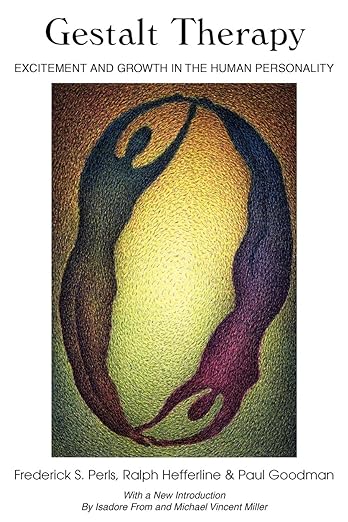
- Perls, F., Hefferline, R., & Goodman, P. (1951). Gestalt Therapy: Excitement and Growth in the Human Personality. — Read my notes
- Perls, F. (1969). Gestalt Therapy Verbatim. — Read my review
- Yontef, G. (1993). Awareness, Dialogue and Process. Gestalt Journal Press.
- Spagnuolo Lobb, M. (2013). The Now-for-Next in Psychotherapy. Sirio Editore.
- Francesetti, G., Gecele, M., & Roubal, J. (Eds.). (2013). Gestalt Therapy in Clinical Practice. Franco Angeli.
- Bocian, B. (2015). Fritz Perls in Berlin 1893–1933. EHP-Verlag.
- Brownell, P. (2010). Gestalt Therapy: A Guide to Contemporary Practice. Springer.
- Wheeler, G. (2000). Beyond Individualism. Gestalt Institute of Cleveland Press.
Gestalt Therapy Videos
Psychoanalysis & Gestalt Therapy Dialogue — Margherita Spagnuolo Lobb & Nancy McWilliams
The Relational Nervous System in Gestalt Body Process Psychotherapy — James Kepner, 2019
Gestalt Couples Therapy — Bob and Rita Resnick, Luana Herek, 2020
New Contemporary Gestalt Therapy — Bob Resnick, 2014
The Field and the Practice of Reciprocity — Margherita Spagnuolo Lobb, 2020
Gestalt Therapy Session — Irving Polster, ca. 2012
Visit gestalt.org/news for the Gestalt news community.